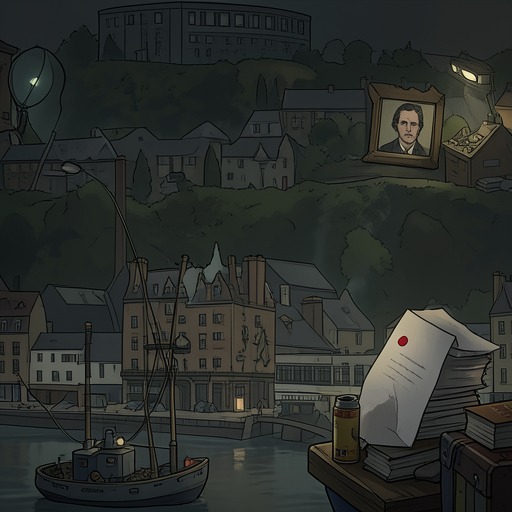
Prison policy of censoring inmate correspondence
Kiss of the Spider WomanThe prison policy of censoring inmate correspondence makes communication with the outside world conditional on institutional inspection. It reaches beyond the handling of individual letters: prisoners know their words may be read, while the prison uses that access to argue that political inmates cannot communicate freely with their comrades. The policy both limits what can pass between people and leaves prisoners uncertain about what has been withheld or lost.
How the Policy Operates
The clearest statement of the rule comes when the Warden tells Molina that Valentin Arregui cannot write to his comrades without the prison seeing the letter first. The Warden presents this control as a reason that Arregui has no contact with the group beyond the prison. The exchange makes inspection a routine condition of correspondence rather than an exceptional response to a particular message.
The rule is also understood by prisoners through experience. When Molina receives a letter, he points out that prison staff had already opened and read it before handing it over. The sender initially assumes that reading the letter aloud will not expose anything new, then realizes that the authorities may open letters whenever they choose. Censorship thus alters not only what a letter can contain but the sender’s and recipient’s sense of privacy: the possibility of inspection is already present before they decide what to share.
A Coded Letter and Missing News
The letter’s contents show how communication persists under inspection. Its ordinary language refers indirectly to joining the movement, political struggle, and a death. Molina explains the code to the recipient: becoming part of the movement is represented as growing old, while life’s trials refer to fighting for the cause. The letter reveals that a fellow member of the movement, only twenty-five years old, has been killed. The news shocks Molina because he had not known of the death.
The delay in learning the news is tied to another letter that never reached him. Molina believes it may have been torn up after the prison opened it, though the text does not confirm what happened to it. The surviving letter therefore performs two opposed functions: it carries news through coded language, yet it also exposes how censorship and interrupted delivery can leave a prisoner isolated from events. Its indirect phrasing is not simply a stylistic choice; it is communication adapted to a setting where private correspondence cannot be assumed.
Censorship as Institutional Leverage
The Warden invokes inspection to dismiss the possibility that Arregui is communicating with his comrades. In the same discussion, Molina maintains that it is better for Arregui to believe he may soon be released, despite the Warden’s confidence that the prisoner has no outside contact. The exchange shows how control over letters becomes part of the prison’s management of information: officials can monitor written messages, while prisoners and staff still disagree about what Arregui knows and what he may be planning.
That access does not make every message transparent. The coded letter requires explanation before its political meaning becomes clear, and the missing earlier letter leaves a gap that neither recipient can resolve. The institution can inspect correspondence without thereby eliminating ambiguity or restoring information already lost. Its power lies partly in controlling the conditions of communication, not in guaranteeing that every message will be understood or delivered.
The Wider Record of Surveillance
The novel later sets the inspection of letters alongside other forms of state observation, while keeping them distinct. After Molina’s release, a report records surveillance by CISL in conjunction with TISL’s wiretap unit and documents his calls and movements. Investigators consider whether the changing feminine names he and a friend use might conceal a code, then judge the exchanges to be a running joke rather than a planned cipher. This episode is not the prison’s letter-inspection procedure, but it echoes its central uncertainty: recorded communication invites official interpretation, and an institution’s access to a message does not ensure that its interpretation is correct.
Together, the prison rule and the later surveillance reports make communication a site of unequal power. Letters may be opened, delayed, or lost; coded language can carry news past ordinary meanings; and institutional records can turn everyday exchanges into objects of suspicion. The policy’s importance lies in this combination of practical restriction and uncertainty, which shapes what prisoners can learn and how their relationships to the outside are represented.